 KIKOMONO
The short answer
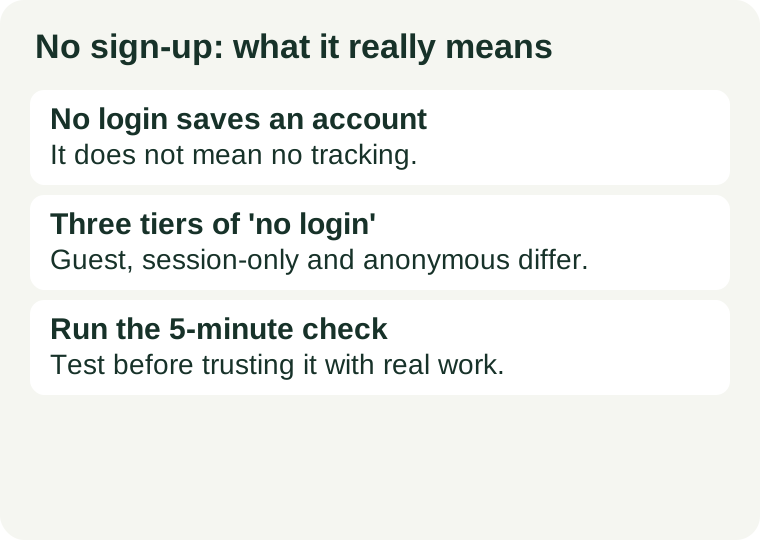
Free AI tools with no sign-up fall into three different grades. First, truly no-account tools let you generate without an email, a password, or a saved history. Second, guest-mode tools let you try one conversation without an account, then ask you to sign in to save, continue, or use more features. Third, explore-only tools let you look around without an account but require one before they produce any output. Only the first grade matches what most people mean by “no sign-up” — and even that grade can still log your IP address, use analytics, or keep prompts for abuse prevention. Treat every no-login tool as a public space until its own privacy page says otherwise, and never paste client data, credentials, unpublished financials, or identifying personal details into one.
Three grades of “no login”
| Grade | What it means | What to check first |
|---|---|---|
| Truly no account | No email, no password, no saved history. You open the page and generate. | Whether output can be saved or exported, and what the privacy page says about retention and training. |
| Guest mode | One conversation or a limited number of generations without an account; history and further use need sign-in. | Where the limit bites: generations per day, saved history, or features behind the sign-in wall. |
| Explore only | You can browse templates and examples without an account, but generating requires one. | Do not count it as a no-sign-up tool. Judge it by its signed-in free plan instead. |
The grade is easy to misread from a landing page. A “try free, no sign-up” button that leads to an explore-only page has not given you a no-login tool; it has given you a demo. Test the grade yourself: open the tool in a private browser window, try to generate a short throwaway draft, and note the exact step where it asks for an account, if it does.
A five-minute check before you paste anything real
Use invented practice text for this check, not your real draft. A short, harmless sentence — for example, a made-up notice about a fictional neighbourhood book sale — is enough to test every step below.
- Generate without an account. Can you reach an output without an email or a sign-in prompt? If not, the tool is explore-only, whatever the headline says.
- Find the limit. Generate twice. Note whether a daily cap, a feature lock, or a sign-in prompt appears, and which one appears first.
- Find the save and export route. Can you copy, download, or save the result without an account? A tool that generates freely but locks export behind sign-in still costs you an account to finish the task. See check a file after exporting it.
- Read the privacy page for four answers. Is your input used for training? How long is it retained? Is it shared with third parties? Can you delete it? If any answer is missing or vague — phrases such as “to improve our services” without a training statement — assume the least private reading.
- Decide what the tool is for. If any of the four answers is unclear, use the tool only for throwaway drafts you could publish without harm. Keep the real version, with names, figures, and decisions, in your own editor. See save your work before you hit a free usage limit.
What “no login” does not guarantee
No account is not no tracking. A site can still see your IP address, set cookies, run analytics, and keep server logs without knowing your name. “Anonymous” in a marketing sentence usually means “no account attached”, not “nothing recorded”.
No account is not no retention. A provider may keep prompts briefly for abuse prevention or debugging even when it does not keep a chat history for you. Retention and history are different things: history is what you can reopen, retention is what the provider still holds.
No account is not no training. Training use is a separate policy choice. A tool can offer no-login access and still use inputs to improve its models, unless its own policy says it does not. Look for an explicit training statement, not for the absence of a sign-in form.
No account is not a safer place for sensitive text. The absence of a password removes one barrier for you and one record for the provider. It does not remove the provider, its subprocessors, or its logs from the path your text travels. If the text would harm you, a client, or a student if disclosed, do not paste it into any free no-login tool.
Match the grade to the job
| Job | Grade that fits | Watch out for |
|---|---|---|
| A throwaway draft or brainstorm you could show anyone | Truly no account, or guest mode | The guest-mode limit arriving mid-draft; save early |
| A draft you need to reopen, revise, and export tomorrow | A signed-in free plan, judged on its own limits | Do not build a multi-day draft inside a guest session with no history |
| Anything with names, grades, client details, or unpublished figures | None of the three grades | Keep it in your own editor; use AI only on a redacted or invented version |
Questions people ask
Is a no-sign-up tool automatically more private than a signed-in one? No. A signed-in tool with a clear no-training policy and a delete control can be more private than a no-login tool with a vague policy. Compare the privacy pages, not the sign-in forms.
Can I trust a tool that says it deletes everything? Only as far as its own policy goes. Check whether deletion covers backups and logs or only the visible history, and whether a retention window is stated. If the policy does not say, treat the claim as unproven and keep sensitive text out.
What if I already pasted something sensitive into a no-login tool? You cannot reliably recall it. Change any exposed credential, tell the affected client or manager if the disclosure matters, and use a redacted or invented version for any repeat work. Do not assume closing the tab deleted the input.
Sources and review scope
This is a decision and verification guide, not a tool ranking. It names no specific no-login tool, because free tiers, guest limits, and privacy wording change without notice; judge any tool by the five-minute check above, on its own pages, on the day you use it. For the wider free-plan picture, see free AI tools for writing and compare free entry points.
Checked 2026-10-25. Free plans change; confirm on the provider's own page before you rely on any limit or privacy claim.