 kikomono-deals
Identify the blocked step first
A usage limit, a conversation-length limit and an unavailable export option are different problems. Record the exact message and any reset time displayed in your account. A new chat is not a guaranteed way to restore an account allowance. Continue only within the provider's permitted access; this workflow preserves work rather than bypassing a limit.
Claude's official usage guidance lists message length, attachment size, conversation length and tool use among the factors affecting usage. It recommends planning requests and giving concise, specific context. This does not establish a fixed number of free messages for your account. This guide does not test a provider's quota or promise a reset schedule.
Build a handoff you can check without AI
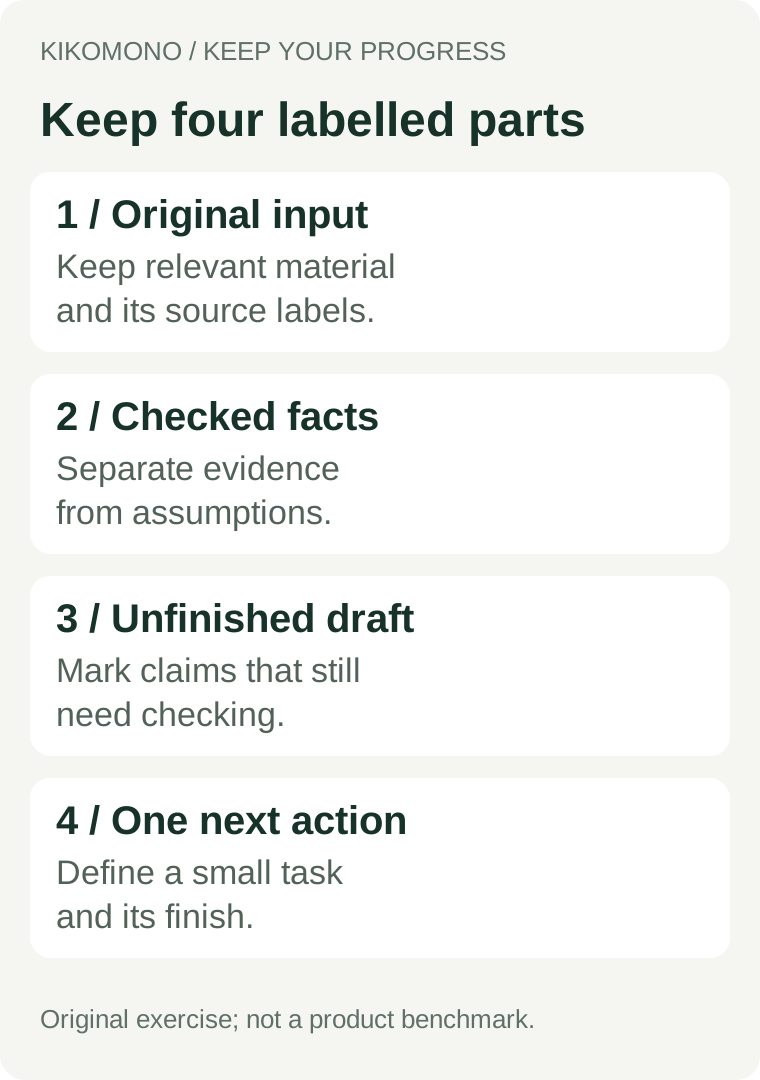
Use four small files or four clearly labelled sections in one document. Name the version and date. The input section preserves the material you actually supplied, including source labels. The checked section contains only claims you have compared with that input. The draft section keeps useful wording but labels unresolved claims. The next-action section asks for one bounded task and defines its finish.
Keep this packet in a destination you control and reopen it before relying on it. A chat title or a link alone is insufficient when the next tool cannot access the old conversation. Preserve relevant source excerpts with their labels, rather than expecting an assistant to reconstruct the missing context. Remove private identifiers before transferring material to another service.
HANDOFF VERSION / DATE:
GOAL AND FINISH:
ORIGINAL INPUT WITH SOURCE LABELS:
CHECKED FACTS AND THEIR SOURCE LABELS:
DRAFT / UNCHECKED CLAIMS:
UNKNOWN OR CONFLICTING DETAILS:
NEXT ACTION — ONE TASK:
ACCEPTANCE CHECK:
If you still have access to generation, you may ask for a handoff using these headings. Compare it yourself before saving. If generation is blocked, copy the relevant parts manually. Do not spend your last available request polishing prose when the original input has not yet been preserved.
Practice with our fictional Cedar workshop
This constructed exercise shows what a useful handoff must retain. It is not a real booking record or an observed AI failure. The similar counts and missing date are deliberate: the next draft must distinguish confirmed participants from people on a waiting list.
S1 — Room note: capacity 8 seats.
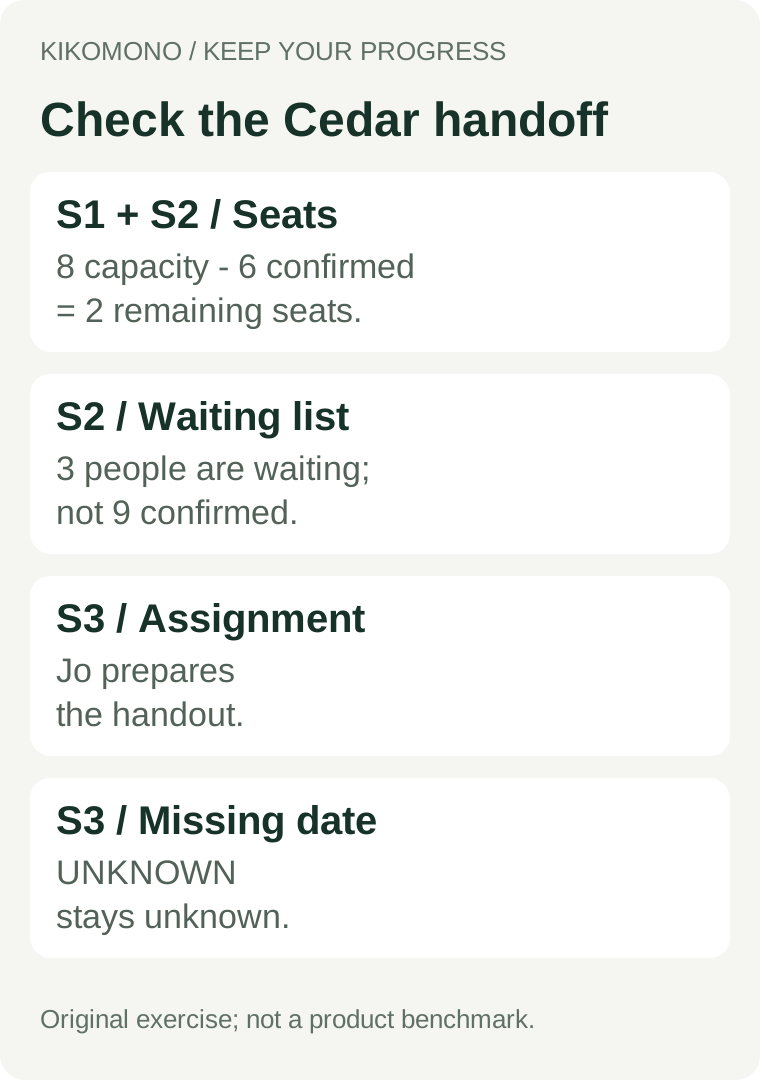
S2 — Booking note: 6 confirmed participants; 3 people on the waiting list.
S3 — Coordinator note: Jo prepares the handout. Session date UNKNOWN.
D1 — Unchecked draft: “Nine participants are confirmed for Friday. Lee will send the handout.”
Save S1, S2 and S3 as input. Keep D1 in the draft section with an unchecked label. Do not turn D1 into a verified summary merely because it reads fluently. The packet should make it possible for someone who never saw the original chat to locate each count and assignment.
Our checked section is: capacity 8 (S1); confirmed 6 and waiting 3 (S2); handout owner Jo and date UNKNOWN (S3). Remaining seats are 8 minus 6, which equals 2, derived from S1 and S2. Nine people have expressed interest across confirmed and waiting categories; that is not nine confirmed bookings. Do not allocate the remaining seats without a separate instruction.
Resume with one bounded request
For this exercise, the next action is a short coordinator update, not a booking decision or a message to be sent. Use this request after attaching the checked packet:
Using only S1–S3 and the checked arithmetic, draft a coordinator update of at most 60 words. Separate confirmed and waiting counts. Preserve UNKNOWN for the date and Jo as the handout owner. Do not allocate seats or send anything. Flag conflicts in D1 instead of adopting them.
An acceptable constructed answer is: “Capacity is 8 seats. Six participants are confirmed and three are waiting, leaving two seats before any new allocation. Jo prepares the handout. Session date: UNKNOWN. The earlier draft's nine confirmed participants, Friday date and Lee assignment are unsupported by S1–S3.”
Check four things before continuing: 6 remains the confirmed count; 3 remains the waiting count; Jo keeps the handout assignment; the date remains UNKNOWN. Check the derived 2 separately against 8 minus 6. A corrected count with an invented Friday date is still a failed handoff. Repair the specific claim and keep the previous version as a record.
Once the packet passes, request only the next useful unit of work. If the task can be completed in your editor using already checked facts, finish it manually. If it requires further generation, wait for permitted access or evaluate a suitable alternative with its current terms and data settings. Switching tools changes the destination, not the truth of your input.
Questions when work stops
What if I cannot send another prompt?
Save readable input and drafts manually. Mark what you checked and what remains unknown. A handoff does not require one more generated summary.
Will a new conversation restore my allowance?
Do not assume so. Read the account's exact limit notice. A shorter conversation may help a context problem, while an account usage limit can still apply.
Should I copy the entire old conversation?
Keep an archive if needed, but supply the relevant input, evidence, draft and next action for the task you are resuming. Omit unrelated material and private details.
Is the Cedar result a model benchmark?
No. It is our worked editorial example with an explicit expected answer. We have not run it as a comparative product test.
Check the saved destination too
After recovery, verify that you can save, reopen and edit the final result. For document input, check OCR text before asking questions. For your first task, use the beginner workflow.