 KIKOMONO
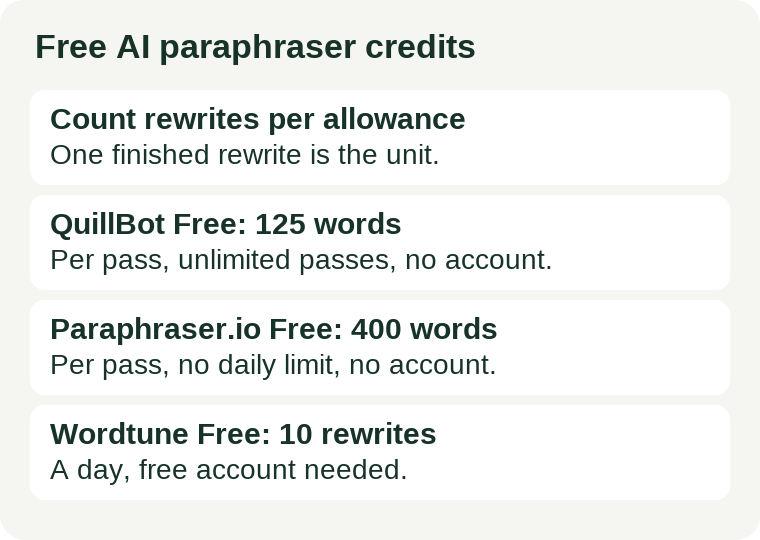
Count finished rewrites per allowance, not words per month
Every click on Paraphrase is a spend, but only the passage you actually keep counts as output. A real rewrite is not one pass. It is a draft, then a fix for the sentence that lost its meaning, then a second version in a plainer tone — two or three spends for one finished passage. Budgeting by “words per month” hides that multiplier; budgeting by passes per finished passage exposes it.
The arithmetic is simple, and it has only two inputs:
Finished passages per allowance = allowance ÷ passes per finished passage.
Passes per finished passage comes from you: how many tries your last real rewrite actually took. The allowance comes from the tool, and it comes in three shapes that must not be confused. Some tools cap the words per pass — QuillBot and Scribbr stop at 125 words, Paraphraser.io at about 400. Some cap the passes per day — Wordtune gives 10 rewrites a day. And one caps characters per spin — Spinbot takes up to 10,000 characters, roughly a thousand words, in a single click.
Run the numbers on a real job. A 500-word email takes four passes on QuillBot, two on Paraphraser.io, one spin on Spinbot — and on Wordtune it depends on how many sentences it holds, because the daily 10 is counted in rewrites, not words. A 2,000-word essay takes sixteen passes on QuillBot, five on Paraphraser.io, two spins on Spinbot, and on Wordtune it does not fit the free day at all if you rewrite sentence by sentence. The cheapest tool is the one whose cap matches the size of the thing you actually write.
What the free tiers actually give — checked 2026-11-25
| Tool | Free allowance | Account | The catch |
|---|---|---|---|
| QuillBot | 125 words per paraphrase, unlimited passes, no daily limit; Standard and Fluency modes | No | One paragraph per pass; the other seven modes are paid |
| Scribbr | 125 words per input, as many as you like; Standard and Fluency modes; no ads | No | Same 125-word cap as QuillBot — it runs on QuillBot’s engine |
| Paraphraser.io | 400 words per pass by the editor counter (page copy says 600), no daily limit; five free modes | No | The page states the cap two ways; plan around 400, and the free editor carries ads |
| Wordtune | 10 rewrites and AI suggestions a day, 3 AI summaries a month, unlimited spelling and grammar checks | Yes, free | Sentence-level only on the free plan; tone and length changes are paid |
| Spinbot | Up to 10,000 characters per spin, free with ads | No | Synonym swapping, not real rewriting — fast, but the output often reads awkwardly |
Two facts in that table decide most choices. First, QuillBot’s 125-word cap is per pass, not per month: you can run 125 words, copy the result, and run the next 125, all day, without paying. That makes it a paragraph tool, and a good one at that size. Second, Paraphraser.io is the only free tier that takes a long passage in one or two passes without an account — but its own page disagrees with itself about the cap, 400 in the editor against 600 in the copy, so budget for 400 and treat anything above it as a bonus.
Wordtune is the odd one out in a different way. Its free plan is counted in rewrites per day, not words, which suits polishing a few sentences in an email and fails completely on a full draft. And there is a fact to know before paying for it: CTech reported in December 2025 that AI21 Labs halted Wordtune development in April 2025 to focus on enterprise customers. The site, the free plan and the paid plans are still live, so treat Wordtune as a finished tool, not one that will gain features.
Match the tier to the job
One paragraph, no account, best quality: QuillBot. The 125-word cap covers most paragraphs, the two free modes are the useful ones, and unlimited passes mean the cap costs you clicks, not money. Scribbr is the same engine with no ads and an academic frame — pick it when the text is a paper or an assignment and you want the citation tools beside it.
A long passage, no account, right now: Paraphraser.io. At 400 words a pass it swallows two or three paragraphs at once, and five modes are free. Accept the ads and the lower polish, and check the output sentence by sentence — it changes wording more aggressively than QuillBot.
A few sentences that must sound right: Wordtune. Highlight a sentence, pick from several alternatives, keep the tone. Ten a day is enough for an email and nowhere near enough for a chapter.
A rough draft to react against: Spinbot. Ten thousand characters in one click, no account, no waiting. Treat the output as a first draft to rewrite yourself, never as finished text — synonym spinners shift meaning more than AI rewriters do, and the result often needs more editing than it saves.
Three checks before you trust a free rewrite
- Read the output against the source, sentence by sentence. A paraphraser’s job is to keep meaning while changing words, and the failure mode is a sentence that reads smoothly and says something slightly different. Names, numbers, dates and quoted terms must come through unchanged — freeze them where the tool allows it, and check them by eye where it does not. Our citation check covers the same habit for AI answers.
- Check what the tool does with your text. A free paraphraser that needs no account still receives every word you paste. Drafts with names, prices or unpublished work deserve a tool whose policy you have read. Our privacy check covers that question.
- Remember that paraphrasing is not authorship. Rewriting a passage does not make its ideas yours, and no paraphraser removes plagiarism on its own. Keep the citation, keep the source in your notes, and check your school or publisher’s rules before submitting paraphrased work. For the same method on grammar, use our grammar credits guide, and for the wider writing shelf, Free AI tools for writing.
When free stops being enough
Two signs, and only two, mean the free tier is the wrong tier rather than a tight one. First, the same real need fails twice for the allowance, not for quality — the essay does not fit in 125-word passes however you split it, or the 10 daily rewrites run out before the email is polished. Second, the free tier’s other conditions block the job: the passage must stay private, the tool needs an account you do not want to create, or the only mode that fits your text is a paid one. A paid plan fixes the first problem; it is the only fix for the second that also changes the terms.