 KIKOMONO
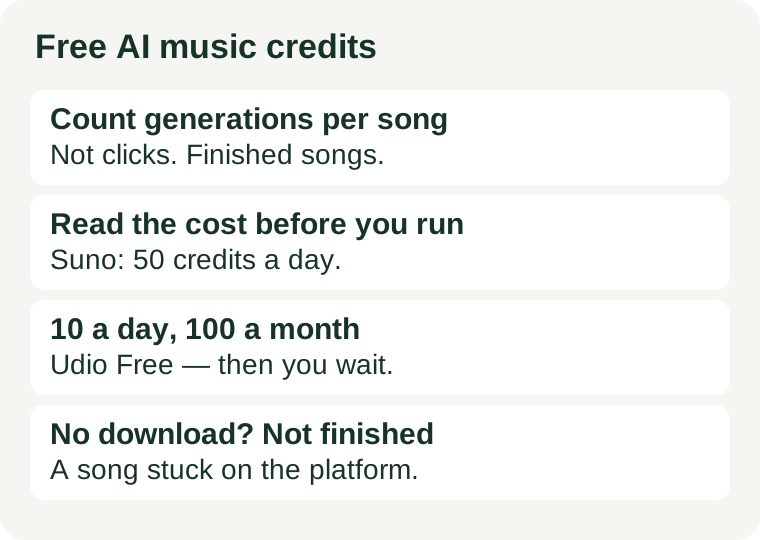
Count generations per finished song, not songs per month
Every click on Generate is a spend, but only the keeper counts as output. A birthday song is not one generation. It is a draft, then a fix for a misheard lyric, then a style change, then an extension because the first version ended too soon — four or five spends for one finished song. Budgeting by “songs per month” hides that multiplier; budgeting by generations per finished song exposes it.
The arithmetic is simple, and it has only two inputs:
Finished songs per allowance = daily or monthly credits ÷ (credits per generation × generations per finished song).
Credits per generation comes from the tool: Suno's help center says one generation makes two songs for 10 credits. Generations per finished song comes from you: it is whatever your last real job actually took. Measure the second number once, and the first number stops being a mystery.
What the official pages say — checked 2026-11-07
Two free plans, two different shapes of limit. The shape matters more than the headline allowance.
Suno Free: the countable one — 50 credits a day
Suno's own pricing page gives free accounts 50 credits a day, on the best free model (v6-mini), with standard features only, uploads of up to 8 minutes of audio, and a shared creation queue. One generation makes two songs for 10 credits, according to Suno's help center, so the daily allowance is about ten songs a day by Suno's own count. The credits do not roll over: the page says credits included in a subscription do not carry over from day to day or month to month. Three hard limits: no monthly song downloads, no commercial rights, and no add-on credit purchases — when the 50 run out, a free account waits for tomorrow. Official pricing page.
This is the only free plan of the two where you can do the division before you start: 50 credits, divided by 10 per generation, divided by the generations your song takes.
Udio Free: the tight one — 10 credits a day, 100 a month
Udio's own pricing page gives free accounts 10 credits a day and 100 credits a month, with no rollover, up to 4 songs generated at the same time, and a limit of 3 full-length (2:10) song generations a day. No credit card is required. Two arithmetic traps hide in those numbers. First, 10 credits a day times 30 days is 300, but the monthly pool is 100 — so ten full days of use empties the whole month, and the daily cap is not the binding limit, the monthly pool is. Second, the 3-a-day full-length cap binds separately: even with credits left, the fourth full-length song of the day has to wait. Official pricing page.
And the biggest limit is not a number at all. Udio's help centre says downloading audio, video and stems is disabled while the platform transitions to a licensed service, so a free Udio song currently stays on Udio. A song you cannot take off the platform is a demo, not a deliverable — fine for trying the tool, not a way to finish a job.
ElevenLabs Music: the shared-pool one — same 10,000 credits as voice
ElevenLabs does not give music its own allowance. Its pricing page gives free accounts one shared pool of 10,000 credits a month across every product, and music costs 900 credits a minute, so the whole monthly pool is about eleven minutes of music — before a single minute of narration, sound effects or dubbing. The credits do not roll over, and the free plan has no commercial license. Official pricing page. Checked 2026-11-06 for our voice credits guide.
The shared pool is the trap: a music experiment and a narration job draw from the same 10,000. Budget them together, or one of them runs dry for the other's sake.
Measure it on your first real job
Do not estimate generations per finished song. Measure it, once, on a job you actually need:
- Write the full brief before the first generation — the style, the mood, the exact lyrics in quotes, and the length.
- Generate, then tally every regeneration until you have a keeper: lyrics fixes, style changes, extensions, all of them.
- That tally is your generations per finished song. For example, a birthday song might take six: one draft, two lyrics fixes, two style changes, one extension.
- Multiply by the credits per generation, and compare with the daily or monthly allowance.
If the result does not fit the allowance, that is a tool-fit signal, not a prompting failure. Either the job needs a tool with a countable allowance, or it needs fewer generations — which is a workflow fix, covered below. Do not solve a credit shortage by re-rolling harder; re-rolling is what caused it.
Four ways to spend fewer credits
- Write the whole brief before the first run. Every “make it happier” re-roll is a spend. Decide the style, the mood and the lyrics first, then generate once.
- Fix lyrics in the prompt, not by re-rolling the song. Re-rolling a full song to fix one misheard line burns the whole generation. Put the exact words in quotes, spell the tricky name phonetically, and check the lyrics field before you generate.
- Change one thing per regeneration. Style, lyrics, or length — not all three. One change per run teaches you what worked; three changes per run teaches you nothing and costs three times as much.
- Batch similar jobs in one session. While the style, prompt and lyrics are fresh in your head, the second and third songs in a set take fewer generations than the first. Spreading one set across a week re-pays the learning cost every time.
When free stops being enough
Two signs, and only two, mean the free tier is the wrong tier rather than a tight one. First, the same real task fails twice in a week for credits, not for quality — the allowance, not your prompting, is the bottleneck. Second, the free tier's other conditions block the job: Suno's free plan has no commercial rights and no downloads, so released work does not belong there, and Udio's free songs cannot be downloaded at all, so any job that needs a file does not belong there either. Our commercial-use check covers the license question in full. A paid plan fixes the first problem; it is the only fix for the second that also changes the terms.
Reviewed 2026-11-07. Free tiers and trial terms change; the provider's own plan page and the cost shown before you generate are authoritative.