 KIKOMONO
The short answer
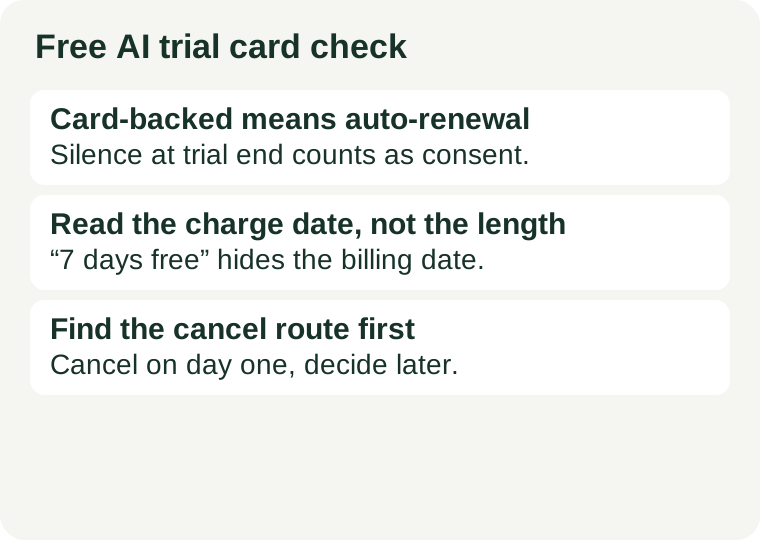
A card-backed free trial is a trial that requires a payment method up front and converts to a paid subscription automatically when the trial ends, unless you cancel first. A free plan, by contrast, asks for no payment method and simply stops or limits you when the free allowance runs out. The difference is not the word “free” on the landing page — it is whether a card is on file and whether silence counts as consent to pay. Before you sign up, run this check: confirm the card requirement, find the auto-renewal sentence, note the exact charge date, and locate the cancel route. If any of those four is missing or unclear, treat the trial as a paid commitment with a free first period, not as a free tool.
Three kinds of “free” you will meet
| Kind | Card required? | What happens when it ends |
|---|---|---|
| Free plan | No | You hit a limit or lose features; nothing is charged because no payment method is on file. |
| Card-backed trial | Yes, at sign-up | It converts to the paid plan on the stated date unless you cancel before then. |
| Card-free trial | No, at sign-up | Access ends or drops to the free plan; you must actively choose and pay to continue. |
Marketing copy blurs these three on purpose. “Start free” can describe any of them, and “no charge today” is true of all three. The question that separates them is not what you pay today but what happens if you do nothing: a card-backed trial charges you for doing nothing, the other two do not. Read the offer for the sentence that answers that question — phrases such as “renews automatically”, “you will be charged”, or “cancel before the trial ends to avoid charges” are the card-backed signal, even when the headline says “free”.
The four-point check before you enter a card
Do this check on the provider's own sign-up and terms pages, before you type in payment details — not after the confirmation email arrives.
- Confirm the card requirement. Does the sign-up form ask for a card, a bank account, or another payment method before any trial feature works? If a payment field appears at all, the trial is card-backed, whatever the headline says. A form that only asks for an email is not.
- Find the auto-renewal sentence. Read the trial terms, not just the pricing page. Note the plan you convert to and its billing period — monthly or yearly — because a yearly conversion costs far more than the monthly figure on the pricing page.
- Note the exact charge date. “7 days free” and “free until 10 November” are different promises. Write down the date and time the first charge is due, in your own calendar, with a reminder at least a day earlier. A trial that ends at midnight in another time zone can charge you while you still think you have a day left.
- Locate the cancel route before you need it. Open the account or billing settings and find the cancel control now, while you are calm and unhurried. If cancellation requires contacting support, waiting for a reply, or completing a retention flow, that friction is part of the trial's real cost — decide whether the trial is worth it anyway.
What to do if you already entered a card
Cancel first, decide later. If the trial no longer looks worth the converted price, cancel immediately and keep the confirmation. Most card-backed trials let you use the remaining trial days after cancelling, so cancelling early costs you nothing and removes the charge risk. If you later decide to pay, you can resubscribe on purpose.
After cancelling, check three things: the confirmation message or email that states the cancellation, the account page showing no next billing date, and your card statement around the trial end date. If a charge appears after a confirmed cancellation, the cancellation record and the charge date are the two facts your card issuer or the provider's support will ask for first. Keep both.
Match the trial to the job
| Job | What fits | Watch out for |
|---|---|---|
| A one-off task you can finish today | A card-free trial, or a free plan | A card-backed trial whose end date you have not diarised |
| A real multi-day test of a paid feature set | A card-backed trial, cancelled on day one | Forgetting the charge date; a yearly conversion price |
| Anything you might keep using casually | A free plan judged on its own limits | Drifting into a paid plan by inaction rather than by choice |
The discipline is simple: a trial you would not pay for is a trial you should cancel the day you start it. That rule also protects your other free-plan checks — a tool that is safe on privacy and export terms, as covered in free AI tools with no sign-up, can still be the wrong choice if its trial converts silently. Judge the trial terms and the tool's limits separately: see check whether free AI output can be used commercially and save your work before you hit a free usage limit.
Sources and review scope
This is a decision and verification guide, not a ranking of trials. It names no specific tool, because trial terms, card requirements, and conversion prices change without notice; judge any trial by the four-point check above, on its own pages, on the day you sign up.
Checked 2026-11-03. Trial terms change; confirm on the provider's own page before you enter payment details.