 KIKOMONO
The short answer
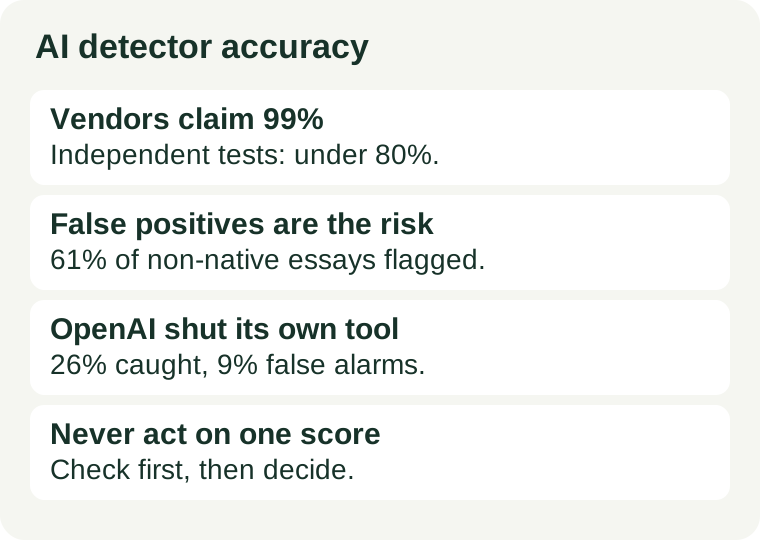
AI detectors measure how predictable a passage looks, not who wrote it. The vendors test them on clean, unedited, single-model text and report 98–99.9% accuracy; peer-reviewed tests on realistic writing — mixed, edited, paraphrased, short, formulaic — found no tool above 80%. The gap matters most where the stakes are highest: a 2023 Stanford study found GPT detectors flagged about 61% of essays by non-native English writers as AI-generated. Before a score decides anything about a person, check the false-positive rate, run your own known-human text through the same tool, and ask for process evidence. Turnitin itself says its percentage should not be the sole basis for action.
What the vendors claim — checked 2026-11-10
Two detectors dominate classrooms, and their official pages make two very different kinds of promise.
Turnitin: under 1% false positives, on its own terms
Turnitin’s official FAQ says it keeps its false positive rate — human-written text wrongly flagged as AI — under 1% for documents with over 20% AI writing: roughly one fully-human document in 100 flagged. Before every model update or new release, it tests on more than 700,000 additional academic papers written before ChatGPT existed. Two conditions hide inside that promise. First, scores below 20% are not shown as a percentage at all: they appear as an asterisk, with no number attached. Second, Turnitin is explicit that the percentage should not be used as the sole basis for action or a definitive grading measure, and that it does not make a determination of misconduct. The same FAQ admits the trade-off plainly: keeping false positives that low means some AI-written text goes undetected. Official FAQ.
GPTZero: 99.9% accuracy, with the same warning attached
GPTZero’s own pages claim 99.9% accuracy when spotting AI-generated text against human writing, a false negative rate under 2%, a false positive rate under 1%, and 96.5% accuracy on mixed documents where human and AI writing are combined. The same pages carry the sentence that matters most: no AI detector is 100% accurate, and results should not be used to punish or as the final verdict. Official site.
Both vendors, in other words, sell a near-perfect number and then warn you not to use it as one. Read the warning, not the headline.
What independent tests found
Vendor numbers come from the vendor’s own test set, on the vendor’s own terms. Independent researchers test on writing that looks like real writing, and the numbers fall.
Fourteen tools, none above 80%. Weber-Wulff and colleagues (2023, International Journal for Educational Integrity) tested 14 detection tools on human and AI-generated text. No tool scored above 80% accuracy, and only five scored above 70%. False positive rates on their test set ranged from 0% (Turnitin) to 50% (GPTZero). Machine paraphrasing — running AI text through a paraphraser — cut accuracy to 26%.
Non-native writers flagged most. A 2023 Stanford study (Liang et al., published in Patterns) tested GPT detectors on essays by non-native English writers and found about 61% of them flagged as AI-generated, against near-zero false positives on native-speaker essays. Formulaic, careful, grammatically regular prose looks predictable to a detector — and predictable is exactly what the detector scores as AI. The bias is structural, not a bug in one tool: detectors reward idiosyncrasy, and learners writing in a second language are penalised for writing correctly.
OpenAI shut down its own detector. The strongest evidence of all comes from the company that built the models being detected. OpenAI launched its AI Text Classifier in January 2023 and discontinued it on July 20, 2023, citing its low rate of accuracy. By OpenAI’s own numbers, it correctly identified only about 26% of AI-written text as likely AI-generated, and wrongly flagged about 9% of human-written text. If the maker of ChatGPT could not build a reliable detector for its own model, a 99% claim from anyone else deserves a second look.
Why the vendor number and the real number differ
The gap is not a lie; it is a difference in what gets tested. Vendor benchmarks use long, clean, unedited passages written entirely by one model, in one sitting. Real writing is none of those things.
- Mixed writing breaks the model. A student who drafts with AI, then rewrites half the sentences by hand, produces a document no benchmark contains. GPTZero claims 96.5% on mixed documents; independent tests put the whole category far lower.
- Editing looks like evasion. Paraphrasing, translating, or heavily revising AI text changes exactly the probability patterns detectors measure. The Weber-Wulff test found paraphrasing alone cut accuracy to 26%.
- Short text has too little signal. Turnitin does not process documents under 300 words of evaluated prose, and scores below 20% are withheld entirely. A short assignment is the case where a detector has the least to work with and the most to get wrong.
- Formulaic writing looks artificial. Lab reports, legal boilerplate, and five-paragraph essays follow patterns by design. A detector that scores predictability will flag the most conventional writing first — which is why non-native writers, who write more regularly, are flagged most.
A detector answers one narrow question: does this text look statistically like the model’s output? Authorship, intent, and process are different questions, and no score answers them.
The five-minute check before you trust a score
Do this before any score is shown to a student, a manager, or a client. It needs no paid plan and no expertise.
- Run known-human text through the same tool. Take an essay, report, or email you know a person wrote — your own old work is ideal — and run it through the detector. If clean human writing scores above zero, you have just measured this tool’s false-positive rate on your kind of text, and it is the only number that matters for your next decision.
- Run the flagged passage through a second detector. Two tools that agree are still not proof, but two tools that disagree tell you the first score was fragile. A verdict that flips when you change the tool was never a verdict.
- Check the conditions the score hides. How long is the text? Turnitin skips documents under 300 words of prose. Is the score below 20%? Turnitin shows no percentage there at all, for a reason. Is the writer working in a second language? Then the Stanford result applies, and the score needs a heavier discount.
- Ask for process, not a confession. Drafts, version history, notes, and search history show how a document was made; a detector score only guesses how it reads. Our lesson-planning guide and free tools for teachers both build in draft checkpoints for exactly this reason: process evidence is checkable, a score is not.
- Decide what the score can and cannot do. A high score is a reason to talk to the writer and look at their process. It is not a reason to fail an assignment, reject an application, or accuse a colleague. GPTZero says so on its own site; Turnitin says so in its own FAQ. If the vendor will not stand behind the number as a verdict, neither should you.
When a detector is still useful
A detector is a triage tool, not a judge. Used as triage, it has real value: it flags the handful of submissions worth a closer look out of a hundred, it starts a conversation about AI use that a policy alone never starts, and combined with drafts and version history it can confirm what the process evidence already suggests. The failure mode is never the tool itself; it is treating a probability as a finding. Keep the score in its lane — a prompt to investigate, answered by evidence a person can actually check — and it earns its place. Promote it to judge, and it will eventually flag the wrong person, most likely the one who wrote most carefully in a language that is not their first.
Sources and review scope
Vendor claims above were read on the providers’ own pages on 2026-11-10: Turnitin’s AI writing detection FAQ (false positive rate under 1% for documents over 20% AI writing; 700,000-paper pre-release testing; scores below 20% shown without a percentage; do not use as sole basis for action) and GPTZero’s official pages (99.9% accuracy, false negative under 2%, false positive under 1%, mixed documents 96.5%; results should not be used to punish). Independent findings come from Weber-Wulff et al. (2023), International Journal for Educational Integrity (14 tools, none above 80% accuracy; false positives 0–50%; paraphrasing cut accuracy to 26%), Liang et al. (2023), Patterns (about 61% of non-native English essays flagged), and OpenAI’s own discontinuation notice for its AI Text Classifier (July 20, 2023; 26% detection, 9% false positives). This article contains no affiliate links. For the companion checks, see our AI citation check and the free AI tools overview.