 KIKOMONO
The short answer
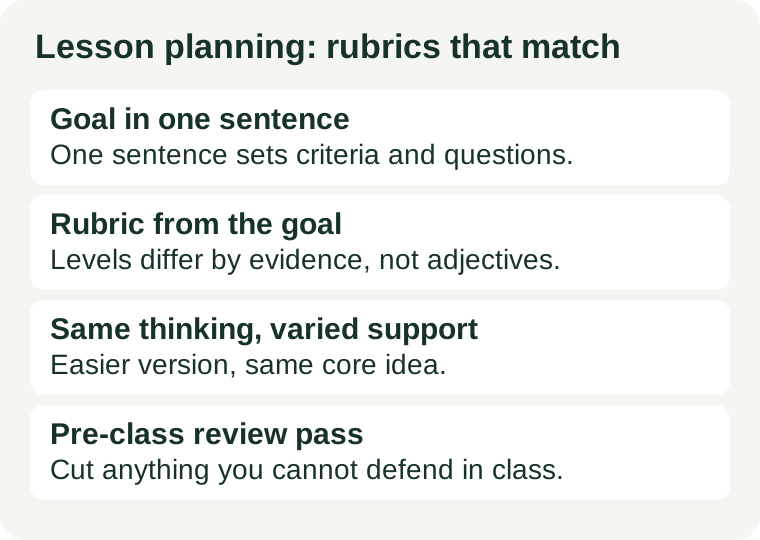
Use a purpose-built teacher tool to draft the structure, then use your own lesson materials to fill it in. Start with the learning goal in one sentence. Draft a rubric from that goal, not from a generic template. Then generate the same worksheet at two or three levels, and check that every level still asks students to do the same thinking — only the reading load and the scaffolding change. If a level changes the thinking itself, it is a different lesson, not a differentiated one. Finish with a pre-class review pass: read every generated item against your source material, and cut anything you cannot defend in class.
Do not start with the tool's template library. Start with your goal, your text, and your marking criteria. The tool fills in the draft; you decide what survives.
Why rubrics and worksheets fail when AI drafts them alone
Most bad AI rubrics share three flaws. First, the criteria describe effort or presentation ("shows good understanding", "is well organised") instead of observable work — so two markers can read the same rubric and award different marks. Second, the level descriptions repeat the same sentence with a stronger adjective ("good", "very good", "excellent"), which tells students nothing about what to do differently. Third, the rubric grades things the lesson never taught, because the tool invented criteria from a generic template rather than from your lesson goal.
Differentiated worksheets fail in a mirror-image way. The "easy" version often removes the hard thinking along with the hard words, so struggling students practise a simpler task while everyone else practises the real one. Or the versions differ only in font size and question count, which is not differentiation at all. A useful check: if you covered up the reading level, could you still tell which version is which from the questions alone? If yes, the thinking changed — and the worksheet needs a rewrite.
A workflow that keeps the teacher in charge
Step 1: Write the goal in one sentence before opening any tool
For example: "Students can explain, in their own words, why the seasons change, using evidence from the diagram." That sentence does three jobs. It sets the rubric criteria (explanation, own words, evidence from the diagram). It sets the worksheet questions (explain, not recall). And it gives you a test for every generated item: does this item serve that sentence, or does it drift into a different topic?
General tools and teacher tools alike produce better drafts when the goal is specific. A vague prompt ("make a worksheet about seasons") returns a vague worksheet. A prompt that names the goal, the source text, and the student level returns something you can actually edit.
Step 2: Draft the rubric from the goal, with observable levels
Ask the tool for criteria tied to your goal sentence, then rewrite each level so it describes something you can see in student work. "Uses evidence from the diagram" becomes observable when the levels say what counts: quotes or points to a labelled part of the diagram, names the diagram's evidence in general terms, or gives no evidence at all. Avoid level descriptions that differ only by adjective. If two adjacent levels cannot be told apart by reading a piece of student work, merge them — a three-level rubric you can apply consistently beats a five-level one you cannot.
Keep the rubric short. Four criteria, each with three or four levels, is enough for most classroom tasks. A rubric longer than the assignment it grades will not be read, by you or by students.
Step 3: Generate the same worksheet at two or three levels
Give the tool your source text and ask for the same questions at different reading levels, with the same learning goal. Then check the one thing that matters: does every level still require the same thinking? The support level may add a word bank, sentence starters, or a worked example. The extension level may remove the scaffolding or ask students to apply the idea to a new example. What must not change is the core task — if the top level asks students to explain and the support level only asks them to copy, the worksheet has split into two lessons.
Read the support version first, not last. That is the version most likely to have lost the thinking, and it is the version your least confident students will meet.
Step 4: The pre-class review pass
Read every generated item against your source material and cut three things: facts you cannot verify from your own text, questions that test a different goal than the one you wrote, and vocabulary or examples that assume background your class does not have. Check numbers, names and dates in generated content against your source — AI drafts invent plausible-looking details, and a worksheet is a worse place for an invented fact than a chat reply, because students will study it.
Then read the rubric and the worksheet together. Every rubric criterion should map to at least one worksheet question, and every worksheet question should map to a criterion or to a clearly labelled practice item. A question with no matching criterion is either ungraded practice (fine, if labelled so) or a rubric gap (fix the rubric).
Which tool for which part
| Job | Start here | Watch out for |
|---|---|---|
| Rubric drafts and worksheet scaffolds | MagicSchool AI | Daily generation limits in a heavy planning week; generic criteria need rewriting into observable levels |
| Reading passages at different levels | Diffit | Free access is limited; check that the easier level keeps the same core idea |
| Feedback comments inside Google Docs | Brisk Teaching | Free teacher plan covers core workflows only |
| Visual worksheets, slides and posters | Canva for Education | Educator verification required before a term's materials depend on it |
| General drafting when no teacher tool fits | ChatGPT or Gemini free tiers | General tools need your own prompts and checking; they invent details more freely |
Tool descriptions reflect the providers' own pages as described in our free AI tools for teachers guide, checked 2026-10-23. Free plans and educator offers change; confirm on the official page before building a term's materials around any one tool. Never paste student names, grades or identifying details into any AI tool — describe students in general terms only.
Three checks before the worksheet reaches students
1. Same thinking, different support? Cover the reading level and compare the questions. If the thinking changed, rewrite the level — do not ship it.
2. Can you mark it consistently? Read two imaginary answers — one strong, one weak — and see whether the rubric separates them without guesswork. If not, rewrite the levels.
3. Does every item trace to your source? Any fact, example or date that is not in your lesson material gets cut or verified before class. A worksheet students revise from must be right.
Questions teachers ask
Should students see the rubric before the task? Yes. A rubric students have not seen is a marking scheme, not a learning aid. Share it with the task, and let students use it to check their own work before handing it in.
How many levels should a differentiated worksheet have? Two or three. More levels multiply the checking work without improving the learning — and each extra version is another draft that can quietly lose the core thinking.
Can I reuse one AI rubric across topics? Only the structure. Criteria and level descriptions must be rewritten for each goal; a rubric carried across topics unchanged is exactly the generic template this workflow is meant to replace.
Is a general assistant enough for all of this? For short drafts, yes. Purpose-built teacher tools earn their place on structured tasks — rubric criteria, leveled readings, feedback comments — where a general prompt has to be rewritten for every lesson.
Sources and review scope
This is a workflow guide, not a performance test of any tool. It draws on standard classroom practice for rubric design (observable criteria, level descriptions that differ by evidence rather than adjective) and differentiation (same learning goal, varied support), and on the tool access information in our free AI tools for teachers guide. No tool prices, plan limits or performance figures are cited here beyond that guide's checked descriptions, because free plans change and the provider's own page is authoritative. Tool pages re-checked in scope 2026-10-25. This article contains no affiliate links.