 KIKOMONO
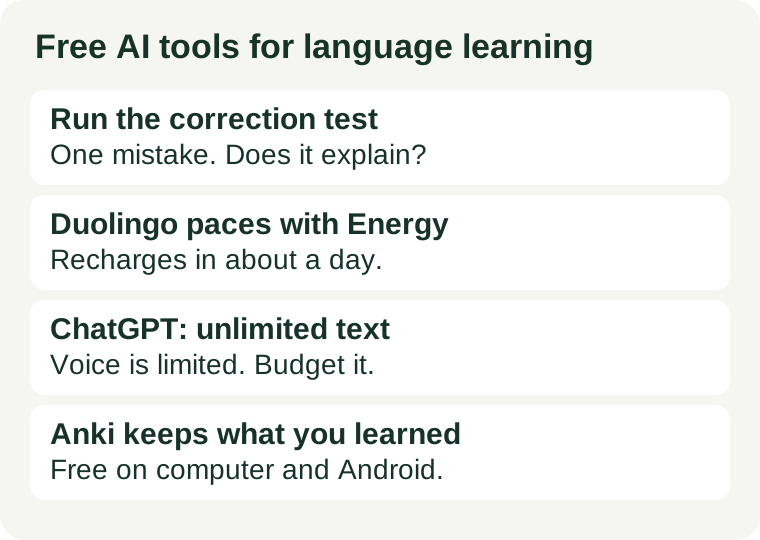
The correction test: one sentence, one deliberate mistake
Pick a sentence in the language you are learning and put one clear mistake in it — the wrong verb ending, the wrong word order, the wrong particle. Give it to the tool and ask what is wrong. There are only three possible answers, and they sort every free tool in seconds:
- It corrects you and explains the rule. This tool teaches. Keep it.
- It corrects you but gives no reason. This tool is a spellchecker with a chat window. Useful for polishing, useless for learning, because you will make the same mistake tomorrow.
- It answers your sentence and ignores the mistake. This tool is a phrasebook. Drop it for learning, however fluent it sounds.
Run the test on the first day, with a mistake you already understand. If the tool cannot explain a mistake you can already spot, it will not explain the ones you cannot.
What the official pages say — checked 2026-11-11
Three free starting points, three different jobs. None of them is a full course on its own.
Duolingo Free: the structured one — lessons paced by Energy
Duolingo’s own blog says the app stays free and explains the limit that paces free study on mobile. Under the old Hearts system, each mistake cost one heart for free learners; the Energy system that replaced it works like a battery instead. You start with full energy, each lesson uses a little, getting several answers in a row right earns some back, and reviewing your mistakes at the end of a lesson costs no energy at all. The battery fully recharges in about a day, and running low leaves two free options: watch a rewarded ad or spend gems. Paid tiers remove the limit. Official blog.
The shape of that limit tells you how to use it: Duolingo is a daily habit tool, not a weekend binge tool. Ten minutes a day fits inside the battery; an hour on a Sunday does not, and that is by design.
ChatGPT Free: the conversation partner — unlimited text, limited voice
OpenAI’s pricing page lists unlimited text chats on the Free plan, subject to abuse guardrails, with voice chats, messages with uploads, image creation, deep research, memory and context all marked limited. The free version is available to everyone, with no card required. Official pricing page.
Unlimited text is exactly what a learner needs for the correction test: paste a sentence, ask what is wrong and why, and repeat until the rule sticks. Two honest limits: voice chats are limited, so speaking practice is the scarce resource and text practice is not, and ChatGPT is a partner, not a curriculum — it will not plan your week, remember what you got wrong last Tuesday, or tell you what to study next. For that half of the job, you need a scheduler, which is the third tool.
Anki: the memory half — free everywhere except the iPhone app
Anki is a flashcard program that schedules each card for review when you are most likely to forget it, so you spend time on what is slipping and less on what you already know. Its own site says the AnkiWeb sync service is free, AnkiDroid for Android is free, and the official iPhone and iPad app is a paid purchase that funds the project’s development. Official site.
Anki is not an AI tool, and that is the point: the AI writes the cards, Anki keeps them. Ask ChatGPT to turn today’s corrected sentences into flashcards — front: the sentence with the mistake, back: the corrected sentence and the rule in one line — and import them. A correction you never review is a correction you will pay for again next week.
The seven-day test: one tool, one week, one verdict
Do not collect three apps and rotate between them. Pick one for the job you actually have, and judge it after seven real days:
- Day 1: run the correction test above. If the tool ignores or unexplains your mistake, stop here.
- Days 1–7: ten minutes a day, same time, same tool. Write down every correction you receive, in one list.
- Day 7: cover the list and re-test yourself on each correction. Count how many you now get right without looking.
- The verdict: if more than half the list sticks, the tool teaches you. If most of it is gone, the tool entertained you — switch tools, not languages.
If the result does not fit, that is a tool-fit signal, not a talent verdict. Either the job needs a different free tool, or it needs the memory half you skipped — corrections without review fade in days, and that is a workflow fix, not a reason to pay.
Four ways to make a free tier actually teach
- Ask for the rule, not the answer. “Correct this and tell me the rule” beats “fix this” every time. A correction without a rule is a fish; a rule is the fishing lesson, and it is the only part that transfers to the next sentence.
- Speak out loud, even in text practice. Read every corrected sentence aloud before you move on. Free voice chats are limited, so do not spend them on reading; spend them on the one thing text cannot check, whether a native ear would understand you.
- Review yesterday’s corrections before today’s lesson. Five minutes on yesterday’s list beats five new lessons. Duolingo itself charges no energy for reviewing mistakes — the tool is telling you where the learning is.
- Do not let translation do the learning. Translating a sentence and reading the result feels like study and teaches almost nothing. Our translation accuracy check covers when machine translation can be trusted — and a translation you did not struggle with first is a sentence you will not remember.
When free stops being enough
Two signs, and only two, mean the free tier is the wrong tier rather than a tight one. First, the same real task fails twice in a week for limits, not for quality — the Energy battery ends your session before your study time does, or voice runs out mid-conversation, and the allowance, not your effort, is the bottleneck. Second, the job itself outgrows what free tools do: an exam with a speaking section, a job interview in the language, or writing a client email all need a human to judge you, and no free tier provides one. Our student tools guide and chat limits guide cover the neighbouring questions. A paid plan fixes the first problem; only a teacher fixes the second.
Reviewed 2026-11-11. Free tiers and trial terms change; the provider’s own plan page is authoritative.