 KIKOMONO
Start with the sentence you will actually send
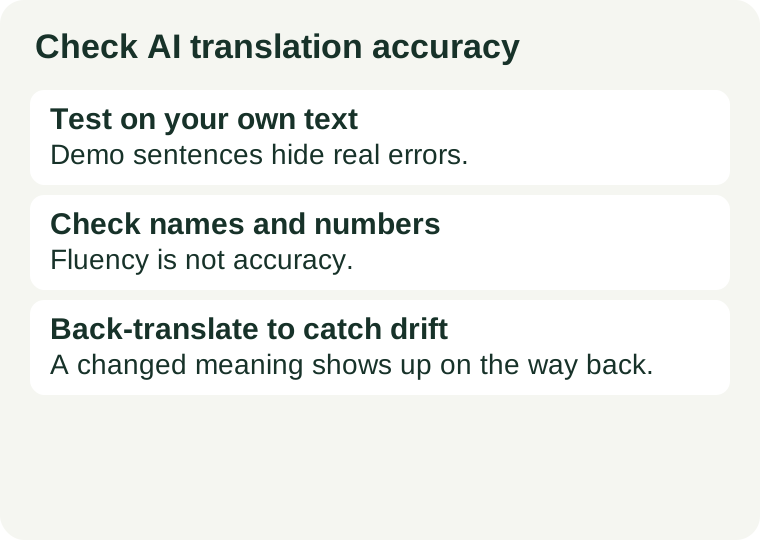
Before you use an AI translation for work, pick the passage that matters: the email, the product description, the instruction sheet. Test the tool on that passage, not on a simple demo sentence. A short, common sentence is the easiest case for any translation model, and a good result there tells you almost nothing about your real content.
Real content is harder. Technical writing uses domain terms a general model may render with the wrong word. Legal or policy text uses defined terms with precise meanings. Marketing copy uses idioms that do not survive a literal translation. If the tool handles your paragraph well, that is useful evidence. If it stumbles, you have learned that before anyone else saw the result.
Check names, numbers and terms, not just fluency
Read the translation the way a recipient would, then compare it with the source line by line. Fluency is the wrong test: an AI writes in the same confident voice whether a detail is right or wrong. Check the items that change outcomes:
| Item | What to check |
|---|---|
| Names | People, products, places and organisations spelled the same way every time. |
| Numbers | Dates, amounts, quantities and units copied exactly, with no rounding or unit swap. |
| Terms | Key words in your field translated the same way throughout the document. |
| Conditions | Words like must, may, only, unless and before kept their force and direction. |
| Negation | No missing not, no turned-around instruction, no softened warning. |
Pay special attention to negation and conditions, because those are where a small slip changes the meaning most. A warning that loses its must, or a deadline that moves from before to after, is a different message even when every other word looks right.
Back-translate to catch drift
Take the translated output and translate it back into the original language with a different tool, or with the same tool in a fresh session. Then compare the result with your original text. If the meaning changed on the way back, something drifted in one of the two passes, and that passage needs a closer look.
Consider an invented example. A source sentence says a workshop is proposed for 20 October and registration is not open. A translation comes back fluent, but the back-translation says the workshop is confirmed for 20 October and registration is open. The words proposed and confirmed, and not open and open, are exactly the details that matter, and the round trip exposed both. The example is invented; the check is the point.
Back-translation is a signal, not proof. If the round trip matches, the translation may still be wrong in a way both passes share. Use it to find passages worth checking, then verify those passages directly against the source.
Translate whole passages, not fragments
Translate a full paragraph or document in one pass where the tool allows it, rather than sentence by sentence. A model that sees the whole passage can keep terminology consistent and resolve pronouns and references from context. Fragment-by-fragment translation produces the same term in different words across sections, and a reader has to guess which one you meant.
When a document is long, keep a small glossary beside it: the fixed translation of each product name, term and proper noun. Check the output against that list before you send it. If the tool drifts from the glossary, correct the drift rather than accepting a new variant.
Know what AI translation must not carry alone
Some content cannot rely on AI translation without a qualified human reviewer. Contracts, medical instructions, safety warnings, visa or immigration documents, and anything you submit to a regulator or a court fall in this group. The risk is not that the translation sounds bad; it is that a fluent error changes an obligation, a dose, a warning or a deadline.
For this kind of content, use AI for a first draft if your policy allows it, then have a person who knows the subject and the target language check the result. If no such reviewer is available, do not send the AI version as final. A delayed translation is cheaper than a wrong one that someone acts on.
Check privacy before you paste
Before pasting work text into a translation tool, check what the provider does with submitted text. Some services keep it to improve their models; others offer deletion controls or a business tier with different retention. The setting matters more than the brand name, so read the provider's own privacy page for the plan you actually use.
Do not paste customer secrets, credentials, identity documents or unpublished business terms into a tool whose retention you have not checked. Use a nonsensitive sample to evaluate the tool first. Our privacy checklist covers the same question for AI tools in general.
A five-minute check before you send
Run this pass on every translation that leaves your desk. It takes minutes and catches the errors that matter most:
- Translate your real passage, not a demo sentence.
- Check names, numbers, terms, conditions and negation against the source.
- Back-translate the riskiest paragraph and compare the meaning.
- Confirm terminology matches your glossary throughout.
- Confirm a human reviewer has seen anything contractual, medical or safety-related.
Scope and further reading
This guide covers checking an AI translation before you use it. It does not rate translation tools or set accuracy scores, and it does not replace professional translation for high-stakes documents. For the same check-first habit applied elsewhere, use the citation checklist for AI answers and the commercial-use checklist before publishing AI-generated content.
Source links on this page are not affiliate links.